Getting an MBBS degree from abroad continues to be a preferred option for many students from India owing to lack of seats and cut-throat competition back home. However, going for studies abroad in medicine requires adherence to some specific laws and policies. The National Medical Commission has come out with some key regulations that every student aspiring for foreign education needs to know prior to applying.
Guide to Regulations for Students Seeking Medical Education Abroad
Knowledge of the Latest Changes for Overseas MBBS Aspirants
It has been emphasized by the National Medical Commission that they do not have any official recognition of the foreign institutions offering medical courses.
Previously, details about foreign medical universities used to be provided by the erstwhile Medical Council of India, but the onus of verifying the curriculum of the institution is now placed squarely on the candidate’s shoulders.
Prior to taking admission in a foreign institution, the candidate must check the following:
- Duration of study
- Structure of the course
- Clinical experiences
- Internship facility
- Language of instructions
Recognized university of the country in which the university operates
Post-graduation licensure eligibility
What Are the Latest NMC New Rules 2026 for MBBS Abroad Students?
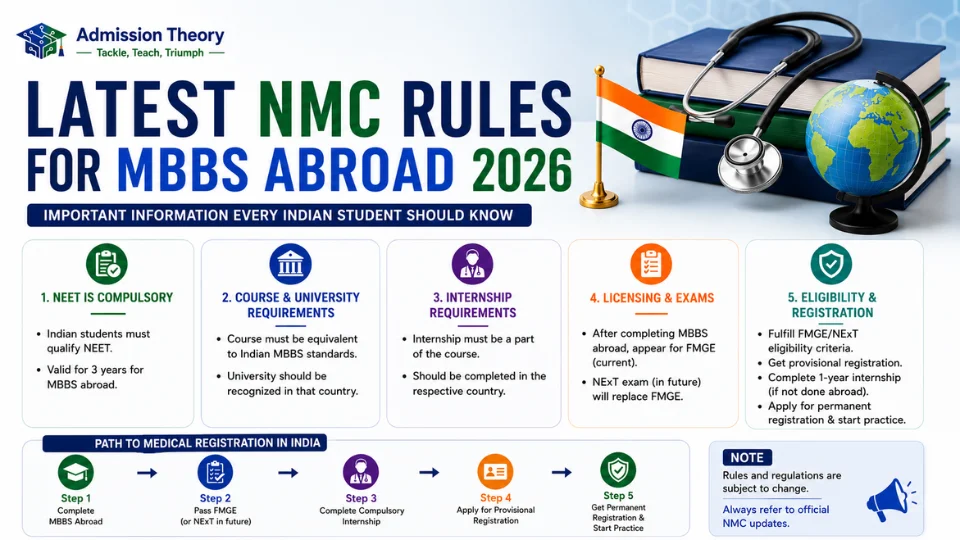
The NMC New Rules 2026 relate to the aspects of Eligibility, Licensing, Internship, Course Structure, and Examination Requirements.
Some of the major changes include:
- NEET Qualification is Compulsory
Indian Students interested in pursuing MBBS abroad from May 2018 onwards must obtain qualification in NEET.
The NEET certificate would act as the Eligibility Certificate for foreign medical studies subject to fulfillment of admission criteria according to Indian regulations.
Validity of NEET:
- Valid for 3 years in case of pursuing MBBS abroad
- Applicable for MBBS or equivalent course
- If attached to pre-medical and languages
- This affects the MBBS Abroad Eligibility requirements directly for Indian applicants.
- Course Structure Should be Equivalent to Indian Standards
As per the latest guidelines of MBBS Abroad by NMC, the foreign medical course should be similar to Indian MBBS course.
Students should check:
- Similarity in academic syllabus
- Minimum period of studies
- Practical training involved
- Internship
- Clinical rotation at hospitals
- MBBS Abroad Course Duration should match medical education norms.
- Recognition of Degree by Local Institution is Required
Any medical qualification which is obtained from another country should enable one to register as a medical practitioner in that country.
This principle constitutes an essential part of NMC Rules for Foreign Medical Graduates since unrecognized local degrees might result in registration challenges in India.
Understanding of the FMGL Regulations 2021 for Indian Students
With the introduction of the FMGL Regulations 2021, there is now an organized way to regulate foreign medical graduates who wish to practice in India.
The key principles include:
- Components Mandatory
- Full physical completion of course
- Clinical rotations incorporated
- Internship completed in foreign country where applicable
- Recognition of degree in source country
- Eligible for licensing in foreign country
These regulations strive to ensure that Indian students obtain adequate training equivalent to the MBBS program locally.
Students often seek out Foreign Medical Graduate Rules since the FMGL regulations influence future registration.
MBBS Abroad Eligibility Criteria According to NMC Rules
In case one wishes to study medicine in another country, one must meet certain MBBS Abroad Eligibility Criteria:
Basic Requirements
✔Indian Citizen/OCI
✔NEET Passed
✔Eligibility criteria satisfied
✔Admitted to recognized medical institute
✔Valid for medical practitioner admission in foreign
FMGE Rules and Licensing Process Explained
Screening examinations will be conducted before registration after completion of foreign medical education by graduates.
According to FMGE Rules as currently in force, students must:
- Have acquired a foreign medical qualification
- Satisfy the FMGE eligibility criteria
- Take the screening examination
- Apply for provisional/registration
- The screening process will retain its importance in the prevailing regulations.
FMGE Eligibility Criteria
As per FMGE Eligibility Criteria, candidates need to have:
- Valid medical qualification
- Recognition of qualification in country of origin
- NEET compliance
- Eligibility Documents
NExT Examination for Overseas MBBS
NExT Examination for Overseas MBBS students is anticipated to serve a very important role in licensing in future.
Objectives of the NExT examination will include:
- Determining clinical competency
- Standardizing medical evaluation
- Eliminating multiple steps
- Licensing process
MBBS students should keep track of developments as implementation dates change.
MBBS Abroad Internship Rules Under NMC
Internship continues to be one of the most crucial topics under recent rules.
MBBS Abroad Internship Rules
Students should ensure:
-Internship is part of the course curriculum
-Clinical exposure is proven
-Pactical training takes place in appropriate locations
-Period is sufficient
The One Year Internship Rule for MBBS abroad students deserves more attention since the internship gap may hinder registration.
FMGE Internship Rules
According to changing FMGE internship rules, graduates may require more supervision in case of lack of compliance.
Students should keep:
-Internship certificates
-Rotation records
-Clinical logbooks
-Hospital documents
These will be handy during the registration process.
NMC Mandatory Internship Rules for FMGs
NMC mandatory internship rules for FMGs strive to achieve equal medical standards.
Significant aspects are:
-Internship verification
-Departments visited
-Period completed
-Practical skills attained
-Evidence of patient contact
Documentation requirements
Keep:
-Degree certificate
-Proof of completion of internship
-Passport records
-Academic transcripts
According to NMC internship rules for foreign medical graduates, documentation plays a very crucial role.
Medium of Instruction and Online Class Rules
The teaching process is another major topic under recent rules.
MBBS Abroad Medium of Instruction NMC Rules
Students should join programs where their medical education is conducted in the language that ensures effective instruction and clinical encounter.
Language issues might affect:
-Patient communication
-Clinical studies
-Licensing ability
NMC Rules for Online Classes in MBBS Abroad
Practical and Physical Clinical Exposure is Essential in Medical Education.
Courses with heavy online classes may be questioned.
Candidates who are thinking of Studying MBBS Abroad must check if class teaching, labs, and hospital rotations happen physically.
Latest FMGE Internship Rules for NMC: Helpful Student Advice
In order to prevent issues in the future:
Do
- Ensure course syllabus
- Check if internship is included
- Keep documents ready
- Make sure you get clinical exposure
- Check licensing rules
Avoid
- Attending unverified schools
- Failing to adhere to internship rules
- Incomplete courses
- Following any unapproved university lists
All these points are relevant to the rules on the licensure of foreign medical graduates discussed earlier for candidates.
Conclusion
Medical study overseas has many positives, but regulatory compliance has never been more crucial.
The Latest NMC rules for studying abroad for MBBS 2026 highlight Quality, Eligibility, Internship, Licensing, and Patient safety. Students are advised against depending on university lists as the commission doesn’t license foreign universities.